Decoupling a Property: The Full Numbers
Decoupling is often presented as a clever way around the Additional Buyer's Stamp Duty (ABSD), and it can be, but it is a real transaction with real costs, and whether it makes sense comes down to the numbers. This is a clear, honest look at what decoupling involves in Singapore, what it actually costs, and when it is worth doing.
What decoupling actually is
Decoupling, formally a transfer or part-sale of share, is when two co-owners of a private property restructure so that one owns it entirely and the other exits. The exiting spouse, no longer holding that property, is treated as not owning residential property for ABSD purposes, so a later purchase can be taxed at the lower first-property BSD rate. For a Singapore citizen buying a $1.5m next property, that is the difference between 0 percent and 20 percent, which is $300,000. That gap is the whole reason people consider it.
It does not work for HDB
This is the first thing to be clear about. Transfers of part-share between spouses for an HDB flat have not been allowed since 2016, other than in specific situations such as divorce, the death of an owner, or a handful of other specific exceptions. Executive condominiums sit in between: decoupling is only possible after the minimum occupation period has been met. As a planning tool, decoupling is really a private property option.
The costs, counted honestly
Decoupling is a genuine sale from one co-owner to another co-owner, so it carries genuine costs:
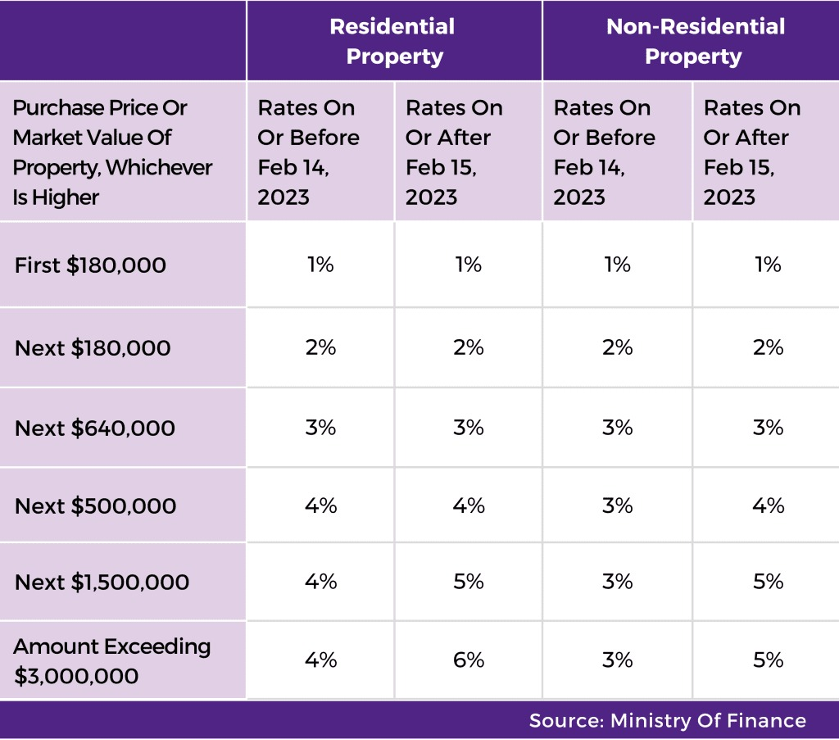
- Buyer's Stamp Duty. The remaining owner is buying the other half share and pays BSD on the market value of that share, on the same progressive residential scale that runs from 1 percent up to 6 percent for the most expensive bands.
- ABSD, if it applies. If the person buying the share already owns another property, ABSD is triggered on that buy-out. Decoupling avoids ABSD on the future purchase by the exiting owner, it does not automatically make the buy-out itself ABSD-free.
- Seller's Stamp Duty, if within the holding period. Since 4 July 2025 the holding period is four years, with rates of 16, 12, 8 and 4 percent from year one to year four. Property bought before 4 July 2025 follows the earlier three-year rule. If the property has not been held long enough, SSD applies to the share being sold.
- Legal and financing costs. Conveyancing fees for the transfer, a possible new or restructured mortgage, and valuation costs. The remaining owner must also qualify for the enlarged loan on their income under the Total Debt Servicing Ratio.
A simple worked example
Suppose a couple jointly owns a private property worth $2m, held long enough that no SSD applies, and wants to buy a second property at $1.5m. Bought in joint names, the second attracts ABSD at 20 percent, which is $300,000. If instead one spouse first buys out the other's $1m half share, that buy-out attracts BSD on $1m, which is only $24,600. That frees the spouse who was bought out to buy the next $1.5m property with no ABSD. Bear in mind that legal fees for decoupling apply, as do financing and bank admin fees if the buying spouse needs a loan, and valuation fees. These are relatively low compared to the BSD payable, and far below the ABSD saved.
The current rates
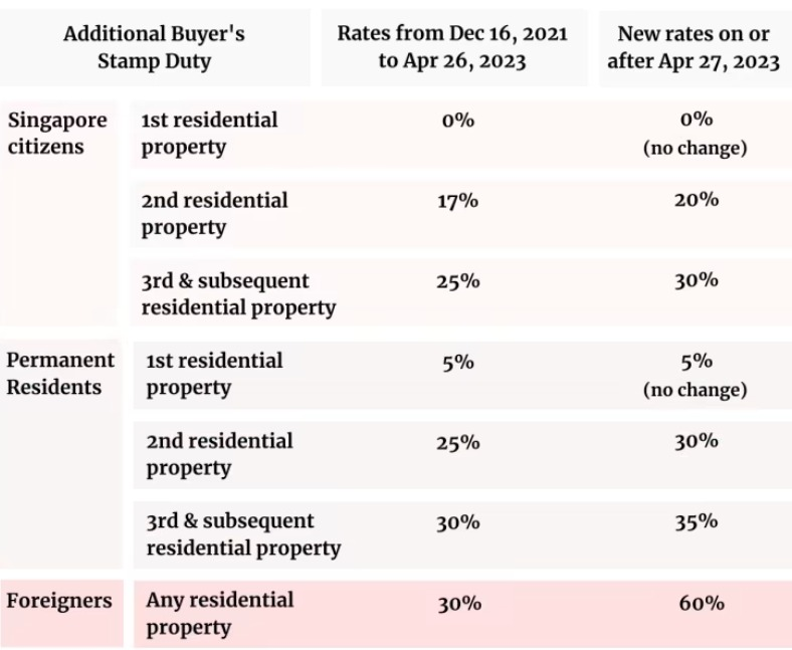
ABSD rates (residential, current)
| Buyer profile | First property | Second property | Third and subsequent |
|---|---|---|---|
| Singapore Citizen | 0% | 20% | 30% |
| Singapore PR | 5% | 30% | 35% |
| Foreigner | 60% | 60% | 60% |
| Entity | 65% | 65% | 65% |
Buyer's Stamp Duty rates (residential, current)
| Portion of price or value | Rate |
|---|---|
| First $180,000 | 1% |
| Next $180,000 | 2% |
| Next $640,000 | 3% |
| Next $500,000 | 4% |
| Next $1,500,000 | 5% |
| Amount above $3,000,000 | 6% |
Rates are current as at the date of writing and can change, so confirm the latest figures before acting.
When it makes sense, and when it does not
Decoupling tends to be worth it when the property attracts little or no SSD, the remaining owner can service the existing loan on a single income, and the ABSD avoided on the next purchase far exceeds the total expense of decoupling.
A word on artificial arrangements
IRAS actively reviews arrangements structured purely to avoid ABSD, including certain 99-1 split purchases, and can claw back the ABSD avoided, with additional financial penalties where an arrangement is found to be artificial and set up for the sole purpose of avoiding ABSD. One such instance is where the exiting co-owner still has a vested interest in the decoupled property. Decoupling done properly, as a genuine transfer of ownership, is legitimate planning. Anything designed only to create the appearance of a transfer is not, and the downside is severe. If you are considering it, do it right or not at all.
Douglas Chow is a licensed real estate professional in Singapore who advises buyers and sellers with an honest, objective approach. He helps clients weigh the real numbers behind residential and commercial property decisions.
Ask Douglas to run your decoupling numbers